Setting the Standard for
Operational AI Reliability Engineering.
We bridge the gap between theoretical AI safety research and practical engineering reality. We define the AI Reliability Enforcement Standards (AIR™-ES), train the enforcers, and govern the certifications that ensure we steer AI to serve humanity safely.
Our Raison d'Être
"AI Reliability is a Public Good. Just as civil engineering standards protect society from collapsing physical infrastructures, AI Reliability Standards must protect us from the unreliability of AI Systems."
The Agentic Crisis
The world has moved from using AI to delegating to AI. As we hand over agency to autonomous systems, the margin for error disappears. Traditional safety measures must be adapted as the decision-making locus moves from humans to AI.
Our Role
We are the independent body responsible for maintaining the AI Reliability Enforcement Standard (AIR™-ES) and governing the Human-Enforced AI Reliability (HE-AIR™) framework.
Our Place in the AI Governance Landscape
"We provide the engineering standards for implementing and enforcing global AI governance frameworks."
The EU AI Act, ISO, and NIST lay the governance mandate for AI security and reliability—but organisations are left to interpret and implement it. The pace of AI development and the complexity of reliability issues make enforcement and monitoring extremely difficult. Our role is to build the standards for AI Reliability enforcement, helping companies engineer reliable AI and regulators certify compliance with confidence. Here is how we complement the major governance frameworks.
Mission of The AI Reliability Institute
(AIRI)
RESEARCH - EDUCATION - CUSTODY
To protect the public from the threats of Artificial Intelligence, Autonomous and Agentic (AAA) by establishing actionable operational frameworks and verifiable technical standards that make AAA systems reliable, prevent algorithmic bias, and ensure accountability in AI-driven outcomes.
Operational Research
To promote and conduct scientific research into the failure modes, risk mitigation strategies, and robust engineering of AAA systems, and to publish results for public benefit.
Education
To advance the education of the public, engineering professionals, and policymakers in the field of AI Reliability, Safety, and Governance. Disseminating open-access standards and curricula.
Custody
To act as the permanent, non-profit custodian of the AI Reliability Enforcement Standards (AIR™-ES) and associated intellectual property in perpetuity for the public benefit.
The Mission Delivery Pillars
Intellectual Assets Creation & Custody
The foundation of AIRI's authority lies in developing and maintaining the intellectual infrastructure for AI reliability.
- Implementation Working Groups
- Technical Working Groups
- AI Reliability Standards (ARS)
- Proprietary frameworks & methodologies
Professional Standards
AIRI establishes and maintains the professional competency framework for AI reliability practitioners.
- Alignment with ISO, EU AI Act, NIST
- Reliability enforcement skills
- Training standards & curricula
- Professional certification programmes
AI Reliability Research
The research pillar drives continuous advancement through systematic investigation and knowledge dissemination.
- AIR proprietary research
- Collaborative research partnerships
- Published research outputs
- Evidence-based knowledge base
Reliability Observer
AIRI maintains active surveillance of the AI reliability landscape through public incident tracking and analysis.
- Public incident entries
- Verified risk catalogue
- Live global AI risks dashboard
- Feedback loop to standards
AI Reliability Risk Tracking
The risk tracking pillar provides systematic monitoring and maintenance of the threat landscape.
- Active monitoring of emergent risks
- AIR-Risks maintenance
- Up-to-date AIR-Risks register
- Vulnerability & mitigation strategies
Integrated Ecosystem
These five pillars operate as an interconnected system rather than isolated functions.
- Research findings inform standards
- Observed incidents drive risk updates
- Training incorporates latest intelligence
- Standards alignment ensures relevance
This integration positions AIRI as both intellectual authority and practical implementation partner globally.
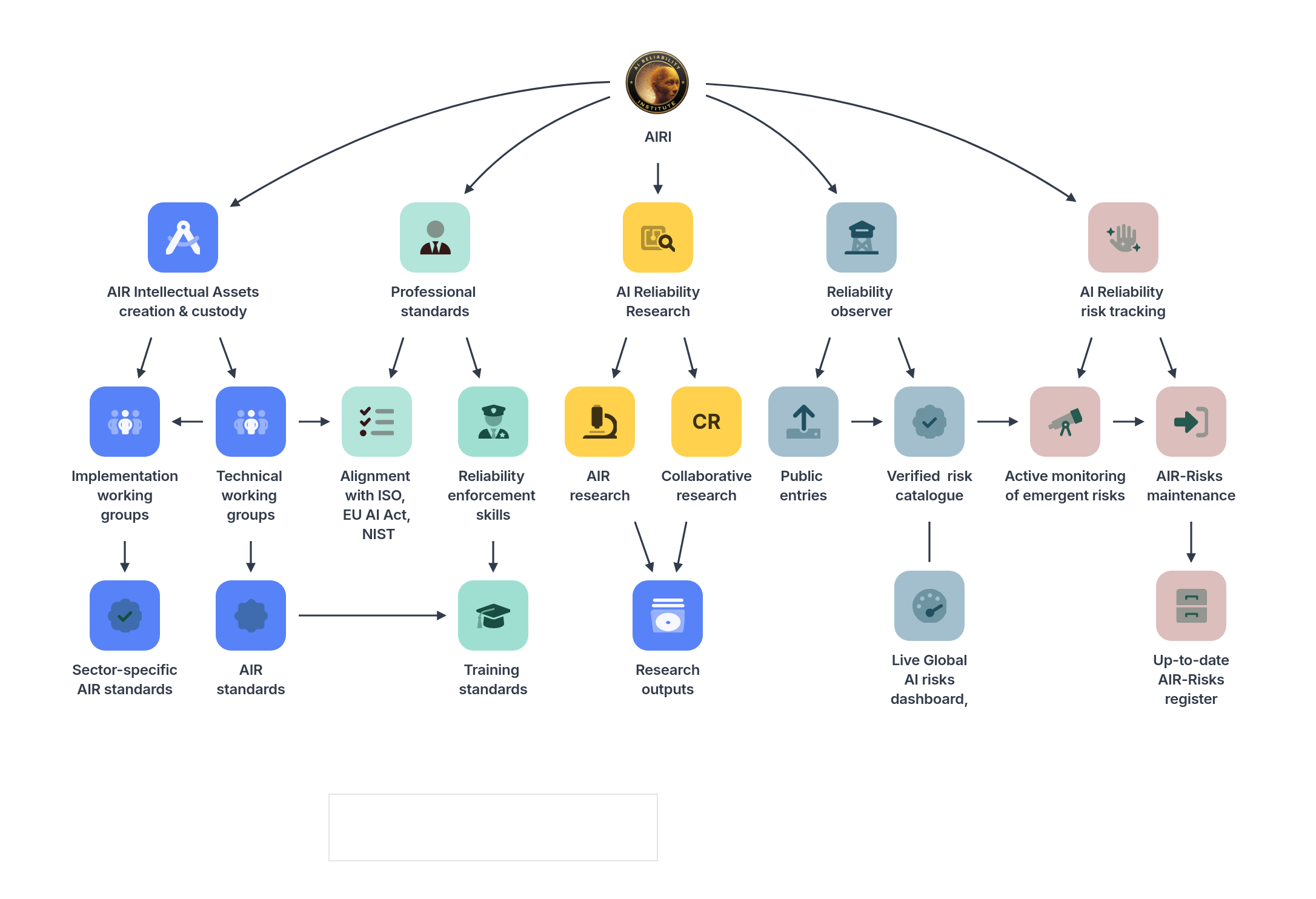
AIRI Organizational Structure: Five pillars supporting global AI Reliability standards
This mission delivery ecosystem reflects our dual mandate: serving as an independent research institute advancing the science of AI reliability, while simultaneously providing the professional infrastructure necessary to translate that knowledge into operational practice across industries and jurisdictions.
The Council of Fellows
The global experts ratifying the Standard.
The Council Of Fellows
The global network
The Council of Fellows comprises global experts in AI reliability, systems engineering, governance, and sector-specific implementation. Fellows are appointed to one or more Working Groups based on their expertise, where they develop the technical frameworks, audit methodologies, and sector-specific standards that constitute the AI Reliability Enforcement Standard ((AIR™-ES).
Fellows contribute to global AI Reliability efforts via the following working groups.
AIR™-TWG(Ops & Control)
Technical mechanisms for real-time control, containment, and operational safety of agentic AI systems.
- Kill switches and emergency shutdown protocols
- Trust Execution Environments & Unreliability Detection
- State observability and monitoring frameworks
- Technical specification for SKS implementation
- Operational reliability checklist (enhanced)
- Reference architectures for containment systems
AIR™-TWG(Architecture & System)
AI Reliability Architecture and System Design. Establishing system-level design patterns and architectural frameworks.
- Multi-agent system architecture
- Swarm reliability frameworks
- Reliability-by-design principles
- Reference architecture library
- Design patterns catalog
- Architecture review templates
AIR™-TWG(Assurance & Audit)
AI Reliability Assurance, Verification and Audit. Creating methodologies for independent verification and forensic audit.
- Audit methodologies
- Conformity assessment procedures
- Evidence collection standards
- Audit methodology handbook
- System card templates
- AIR™-Auditor curriculum
AIR™-TWG(Governance & Risk)
AI Reliability Governance, Risk and Regulatory Alignment. Defining organizational governance frameworks.
- Board-level AI governance
- Risk appetite definition
- Regulatory compliance mapping
- Board governance playbook
- Risk appetite frameworks
- AIR™-Officer curriculum
AIR™-IWG(Software Development)
AI Reliability in Application Development and DevOps. Translating reliability frameworks into practical guidance.
- AI-assisted coding reliability
- MLOps and AIOps patterns
- CI/CD pipeline integration
- Developer reliability handbook
- Code review checklists
- CI/CD integration templates
AIR™-IWG(Development Sector)
AI reliability standards for international development, humanitarian aid, and sustainable development goal initiatives.
- AI for development & response systems
- Resource allocation algorithms
- Cross-cultural AI deployment
- Development sector reliability handbook
- Reliable NGO AI deployment guidelines
- Reliable AI-Enabled impact assessment frameworks
AIR™-IWG(Healthcare)
Medical AI reliability standards for diagnostic systems, treatment planning, and clinical decision support.
- Clinical decision support validation
- Diagnostic AI safety protocols
- Patient data privacy safeguards
- Medical AI reliability handbook
- Clinical validation frameworks
- FDA/EMA compliance guides
AIR™-IWG(Education)
AI reliability standards for educational technology, adaptive learning systems, and academic assessment tools.
- Adaptive learning system reliability
- Student assessment fairness
- Educational data privacy safeguards
- EdTech reliability playbook
- Student protection frameworks
- Academic integrity guidelines
AIR™-IWG(Government)
AI reliability standards for public sector applications, smart city systems, and government service delivery.
- Public service AI accountability
- Smart city infrastructure reliability
- Citizen data protection standards
- Government AI reliability handbook
- Public procurement guidelines
- Democratic accountability frameworks
AIR™-CCWG(Standards)
AI Reliability Standards Development and Harmonization. Coordinating AIRI's contributions to international standards bodies.
- ISO/IEC JTC 1/SC 42 Strategy
- NIST & RMF Alignment
- AIR™-Standards Version Control
- Shadow Draft Proposals
- AI Reliability Lexicon
- Standards Consultation Responses
The global community monitoring AI Reliability in production
AI Reliability Observer
The Observer is our public-facing incident intelligence hub where practitioners worldwide report aberrant AI behaviors they encounter in real deployments. The observer offers: